Welcome to our Blog

Click here to read the what this blog is all about.
Click here to see a listing of posts arranged by category.
Showing posts with label Carmel Ruins. Show all posts

Saturday, February 12, 2011

Hurricane Katrina

On August 29, 2005, Hurricane Katrina hit the southern Gulf coast of the United States and caused severe destruction. New Orleans, LA was hit particularly hard, and 80% of the city was flooded. Five and a half years later, there are still people living in temporary accommodations. The U.S. government made the decision to rebuild New Orleans, and a study was carried out to decide which parts to abandon and which buildings needed to be elevated.

In a recent news report, the AP reported that 43,000 residential properties are sitting abandoned in New Orleans. Every night 3,000 homeless people squat in these house. Another video, produced by National Geographic, shows the impact of the storm on Southern Mississippi University.

Friday, December 10, 2010

Ruins in Israeli Art

In a Hebrew essay entitled "Ruins, Demolitions and Destruction" (lit. Chorvot, Harisot, Churban), Gideon Efrat catalogs the various ways in which ruins have been depicted in Israeli art. He finds over a dozen separate categories and demonstrates just how significant ruins are in the Israeli psyche.
"More and more Israeli artists have made the ruin a fundamental topic in their work, in response, among other things, to the local and world-wide historical-political situation."
For our project, this is encouraging, and only emphasizes how relevant a project about preservation of ruins is in this country.

Luigi Mayer - Sepulcher of Rachel (1803)
David Roberts - Gate of Baalbek (1842-9)
William Henry Bartlett - Tomb of Kings
David Roberts - Gaza (1842-9)


Some early Zionist artists were less Romantic, yet still chose to depict ruins as friendly and innocuous sites, without thought as to the significance or implications of the ruins. Others showed ruins as metaphors for loss and destruction. This approach still did not personalize the tragedy implicit in ruins, and they remained somewhat Romantic.
Anna Ticho - Bitania (1935)


Shmuel Charuvi - Landscape (1930)


As the struggle for an independent state increased, Zionist artists downplayed ruins, preferring to depict positive building rather than destruction. However, ruins were still occasionally used to show the revival of the Jewish people and the rise of the Jewish State. This is also connected to a national enthusiasm for archaeological ruins as a way of showing ancient Jewish connection to the land and thus ownership.


Jakob Steinhardt (1950)


Following the War of Independence, another treatment of ruins began to appear in Israeli art, one that, according to Efrat, is connected to the act of destruction and a feeling of guilt. The ruins of Arab villages were now a part of the landscape. In particular he mentions Marcel Janco as the most famous employer of ruins in Israeli art. He painted ruined villages, but also later became the head of the Park Department of Israel. In this capacity he planned out several national parks, many of which were dotted with ruined villages. We also sometimes see cleansed ruins of 1948, without any pain involved, as picturesque objects. Efrat feels that depictions of Arab ruins in this stage were not explicit enough. In Janco's Ein Hod Landscape, for example, there is a line of Arabs traveling, but it is not clearly understood that these Arabs are refugees from the village. Efrat asks:
"The paintings of Ein Hod by Marcel Janco: moral obsession identifying with the human tragedy of the 'others', or perhaps celebration of dynamic shapes and colors? It seems that the inability to answer definitively is also the answer to our question."
Jacob Eisensher - Ruins

Marcel Janco - Arab Village

Marcel Janco - Ein Hod Landscape


Although this post could go on and on, I'm going to have to cut it short and add that ruins are also used in Israeli art to refer to:
the Holocaust;
political ruins caused by punitive bombings by Israel and its neighbors;
demolition of houses in the West Bank;
evacuations of Yamit / the Gaza Strip by Israel;
terrorist bombings;
and to archaeology and post-modernism.

In short, this is a topic with a very rich history in the Israeli conscience and multiple layers of meaning.

Wednesday, December 8, 2010

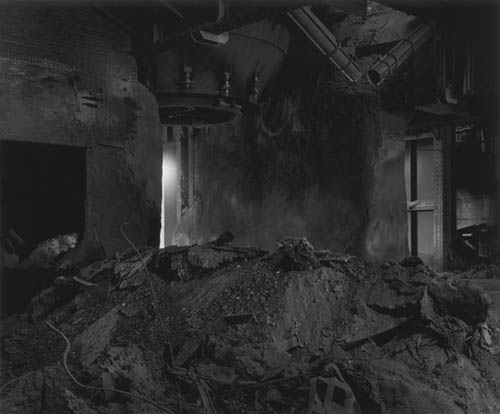
Gilbert Fastenaekens and Nighttime Ruins

Gilbert Fasternaekens is a contemporary Belgian photographer who often takes pictures of urban landscapes at night. In particular, he has taken many photos of post-industrial sites.

These images speak about the effect of lighting and time of day on ruin perception, and demonstrate the power and drama of modern industrial ruins.

Ruins in The Built, the Unbuilt, and the Unbuildable


Robert Harbison's book, whimsically titled The Built, the Unbuilt, and the Unbuildable, contains a chapter titled "Ruins" which is equally whimsically. The chapter itself lacks a thesis or direction, but is rather a connect-the-dots brainstorm of ideas about ruins without much editing. Still, there are a couple of interesting thoughts that Harbison hits upon. He suggests that ruins can be classified, writing:
"We need a careful series of the degrees of ruin like a paint chart or a colour wheel as one adds further minute amounts of white (that is, of passage) to the basic tone."
While it's rather unclear what he means in the context of his paragraph, the idea itself is intriguing. Asi Shalom did something along this line when he graphed ruins as a function of time versus the percentage of the building that remained. Harbinson seems to want to chart ruins based on how long it takes them to deteriorate, from instantaneous ruins to ones that decay glacially. Other charts are possible as well, and remain to be suggested.

Harbison also explains that ruins have a lot to do with the psychic state of the viewer. We are apt to recall our own personal attachment to a site and disregard previous or later strata. Thus,
"When a childhood scene is cleared to make way for something else or perhaps for nothing else, one's first thought is not of those who lived there last, one's successors, but of one's old sensations which are now a book abruptly closed."
When dealing with a layered site like Rosh Ha'ayin, there is a Jewish memory attached with the site that dates back millenia, but is so detached and minor that it is hard to cleave to it. There are other Israeli cultural associations with the site, and there are certainly memories attached to Arab and Crusader periods. However, I personally have no overwhelming association with the site. Perhaps this will give me clairvoyance when choosing what to do with its ruins; or, perhaps it means I am not in the least bit qualified to address its ruins. Still, it is important to recognize the importance of memory - and memories can sometimes be misleading or invented - when dealing with ruins.

Finally, Harbison dedicates a large percentage of his chapter modern, industrial ruins. He explains that they are unique, in that they may still be alive, but are also in danger as they are seen as machines with little aesthetic appeal.
"Ancient ruins vividly depict the passage of time, but it is now almost frozen. By noticing them we remove them from the buffeting stream. Industrial ruins are most special in this: though large and powerful they feel extremely vulnerable. No one is going to keep them just for a spectacle, so the richer they become as ruins, the nearer and surer their demolition approaches. Only ruins only look doomed anymore, these plants and factories are."
I would venture that the modern ruins in Rosh Ha'ayin are similar - few people would consider leveling Tel Aphek or Migdal Zedek, yet the utilitarian, workaday ruins of the British buildings in Rosh Ha'ayin, especially those that have deteriorated, are in danger of being erased. In this case, the question is not whether to preserve them as functioning building, but rather should we preserve them at all. We believe they should be preserved, and that preservation as ruins serves as good, if not a superior, function.

Robert Harbison, The Built, the Unbuilt, and the Unbuildable: In Pursuit of Architectural Meaning. (London: Thames and Hudson, 1991), 99-130.

Sunday, December 5, 2010

Fresh Ruins: The Carmel

The last few days in Israel have seen a terrible natural disaster - a forest fire near Haifa that has only now, four days later, come under control. The fire has devastated several local settlements and left ruins in its wake. It's a stark reminder that ruins often begin under terrible circumstances. Here are some pictures by Tal Cohen, Flash 90 and Yaron Kemenitsky.